Most startups are ready for outsourced accounting the month their books stop answering the questions leadership is asking. For a lot of founders, that month arrives with the first real hire. For others, it comes with a lender review or a close that keeps slipping past the middle of the month.
Agency founders already work this way. You hand media buying or design to outside specialists because building those teams in-house costs too much and takes too long, and finance follows the same logic. Accounting outsourcing moves your accounting and financial control work to an outside team. For many growing companies, it's the most practical route to outsourced accounting services for growth without adding a full-time finance hire.
TL;DR Quick Answers
Outsourced Accounting Services for Growth
Outsourced accounting services for growth give a growing company a team that reviews its books, controls spending and forecasts what comes next, without a full-time finance hire. The service builds on your bookkeeping instead of replacing it, and the scope expands as you add people, revenue and investors.
What's included: a reviewed monthly close, AP approvals and AR follow-up, payroll and labor cost tracking, budgets and forecasts, internal controls and custom reports.
When it fits: your close runs late, you're making your first hires, investors or lenders want reports, or an audit or raise is coming.
Why a team matters: your books don't depend on one person.
How it works: inside the tools you already use, like QuickBooks Online, Bill.com, Gusto and Ramp.
Cost: typically less than an in-house hire, with Accountix starting at $350 per week.
Getting started: a free 30-minute intro call, then onboarding in about four weeks at Accountix.
Top Takeaways
Bookkeeping records the past, while outsourced accounting adds controls, forecasts and reports you can act on.
Late closes, reporting requests from investors or lenders, growing payroll complexity and an upcoming audit or raise are the clearest triggers.
An in-house accountant's median salary is $81,680 (BLS, May 2024), and benefits and taxes come on top.
The right outsourced accounting partner scales with you and works inside the tools you already use.
Clean, separated accounts and a full tool inventory make the handoff faster.
Bookkeeping vs. Outsourced Accounting: What Actually Changes
Bookkeeping records what happened. Outsourced accounting checks those records and uses them to plan the next quarter.
You keep your bookkeeping when you switch. It becomes the foundation, and the accounting layer on top changes who reviews your numbers and how quickly they reach you.
Transactions
Bookkeeping: Records and categorizes every transaction
Outsourced accounting: Reviews entries and adds accrual adjustments so revenue and costs land in the right month
Reconciliations
Bookkeeping: Matches bank and card statements
Outsourced accounting: Checks balances against your controls and flags gaps early
Bills and invoices
Bookkeeping: Enters bills and tracks invoices
Outsourced accounting: Sets spending approvals and follows up on late payments
Payroll
Bookkeeping: Posts payroll
Outsourced accounting: Assigns labor costs by client, project or department
Month-end
Bookkeeping: Closes the books
Outsourced accounting: Reviews the close so leadership can act on the numbers with confidence
Reporting
Bookkeeping: Delivers basic monthly statements
Outsourced accounting: Builds custom reports, budgets and forecasts
Controls
Bookkeeping: Not included
Outsourced accounting: Puts internal controls in place to lower the risk of errors and fraud
Lenders and investors often expect accrual-based statements. According to the SBA, private companies don't have to follow GAAP, so the right method depends on who reads your financials.
Six Signs Your Startup Has Outgrown Basic Bookkeeping
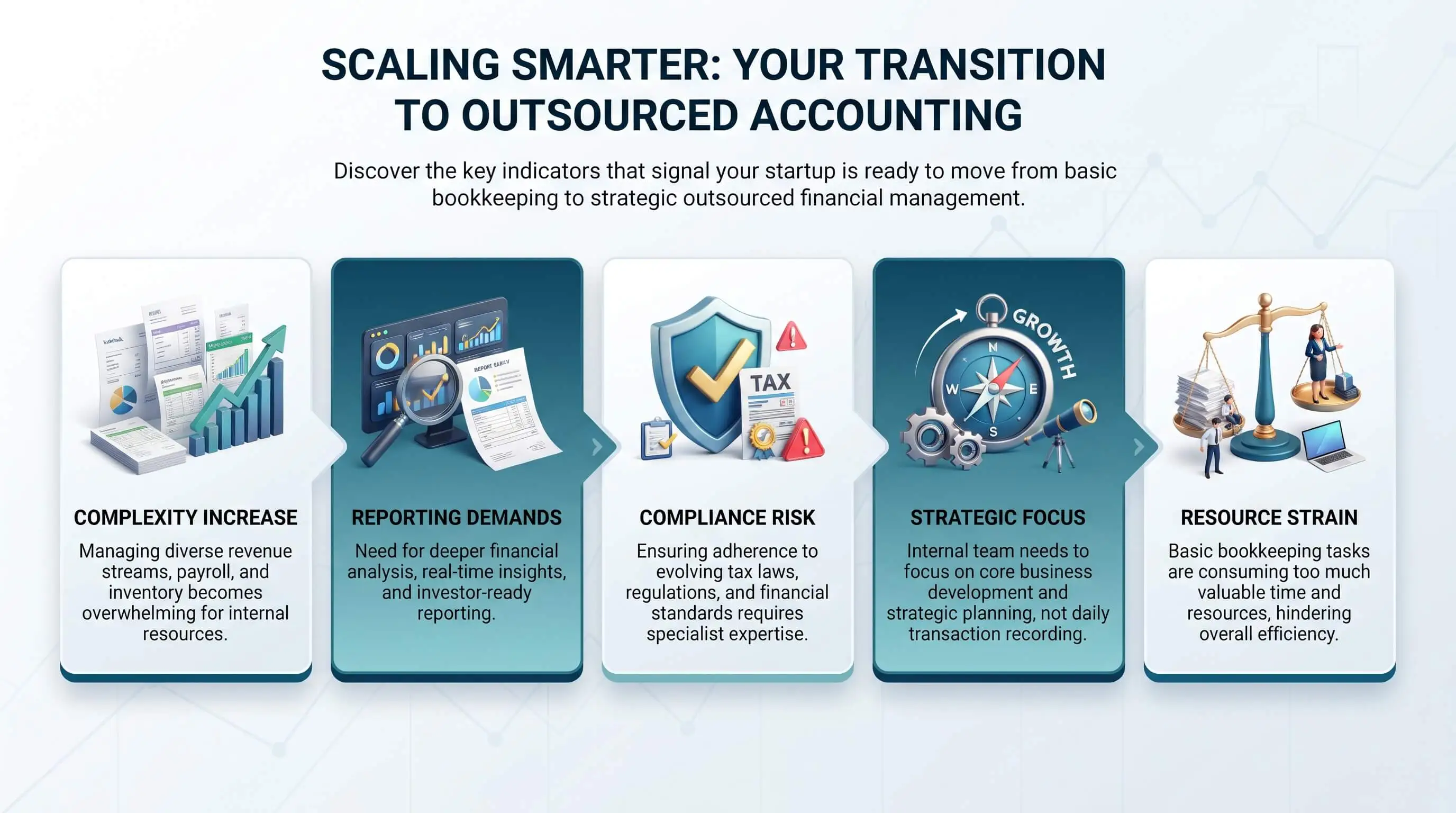
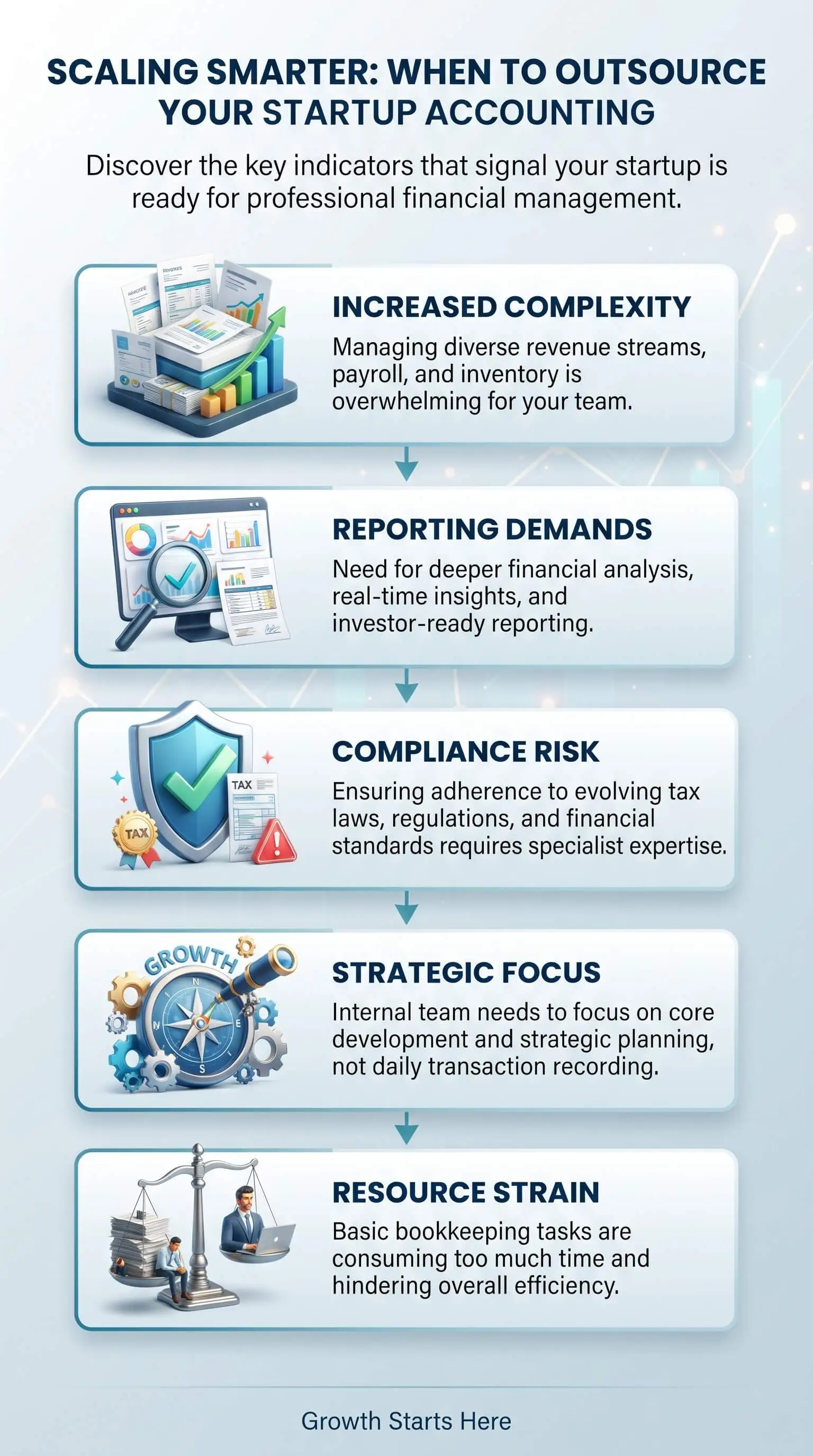
Your books close late, or your bank, payroll and accounting tools disagree.
An investor, lender or board member asks for accrual statements, forecasts or budget-vs-actual reports.
Answering "how much runway do we have?" takes days.
Payroll keeps getting harder as you add employees, 1099 freelancers, commissions or staff in another state.
You have an audit, due diligence review or funding round on the calendar.
You spend hours each week on finance work that should go to clients or products.
Cash flow tends to show the strain first. In a 2025 QuickBooks survey, 43% of small businesses said cash flow is a problem for them.
When to Outsource Accounting: A Stage-by-Stage Timeline
No single revenue figure flips the switch. Use these stages as a guide.
Pre-revenue
What it looks like: A handful of transactions, with the founder running the books
What you likely need: Accounting software plus a part-time bookkeeper, or DIY
Early revenue
What it looks like: Steady sales and your first contractors
What you likely need: Monthly bookkeeping
First hires
What it looks like: Payroll, more revenue streams and closes that run late
What you likely need: Start evaluating outsourced accounting
Scaling or raising
What it looks like: Revenue nearing $1 million, 10 or more employees, and investors asking for reports
What you likely need: Outsourced accounting
Strategic planning
What it looks like: Fundraising models, pricing decisions and scenario planning
What you likely need: Add a fractional CFO
Read these as signals rather than rules. A six-person agency running 40 client retainers can need more accounting support than a 15-person company selling one product, making it important to consider when to hire an outsourced accounting firm.
What Outsourced Accounting Services for Growth Should Include
The right outsourced accounting services for growth scale with you and work inside the systems you already have. Look for:
A monthly close with a second set of eyes on it
Accounts payable approvals and accounts receivable follow-up
Payroll and labor cost tracking
Budgets and forecasts
Internal controls
Reports your leadership team will read and use
Integration with tools you already use, like QuickBooks Online, Bill.com, Gusto or Ramp
Before you sign, get clear answers to these:
Who reviews my close, and how often?
Which reports will I get every month?
What happens if my main contact is out?
Push hardest on that last one. With a single in-house accountant, one sick week or one resignation can stall your close. Accountix, an outsourced accounting firm in Santa Barbara, California, builds its service around a team so your books don't depend on one person.
What It Costs Compared With an In-House Accountant
Salary tells only part of the story. The Bureau of Labor Statistics reports a median annual wage of $81,680 for accountants and auditors as of May 2024, and that figure leaves out payroll taxes, benefits, software and recruiting.
Outsourced pricing depends on scope. Accountix's outsourced accounting starts at $350 per week, about $18,200 a year at that starting rate, and the team sets fixed pricing after a discovery call.
Hiring takes time, too. The BLS projects about 124,200 openings for accountants and auditors each year through 2034, so you'd be competing with every other company trying to fill the same seat.
When It's Still Too Early
Some startups don't need this yet, and that's fine. If your transaction volume is low, you have no payroll and no outside investors or lenders, and you can review your books each month without strain, clean bookkeeping covers you for now.
Pick a trigger and revisit the decision when it hits. It might be your first hire, your first raise, or the first month your close runs more than a couple of weeks late.
How to Prepare for a Smooth Handoff
Separate business and personal accounts.
List every financial tool and who owns each login, from bank and cards to payroll, invoicing and expense apps.
Gather contracts, loan documents, your cap table and past tax returns.
Check how long you need to keep records. The IRS spells it out.
Choose the reports you want every month and decide who will read them.
For an LA creative shop, this step often means separating pass-through client ad spend from actual revenue and tracking margin by project. Set that structure up at the start, and every report after it gets more useful.
"Bookkeeping tells you where your money went, and accounting helps you decide where it should go next. In our onboarding work, the trigger is rarely a crisis. Usually a founder wants to make a hire and can't say for sure whether cash will cover it six months out. The founders who switch at the right time are the ones who started asking questions their books couldn't answer, whether or not anything had broken."
7 Essential Resources
Wikipedia: Accounting outsourcing. A plain overview of what outsourced accounting covers and where it helps or falls short.
SBA: Manage your finances. The Small Business Administration's guide to accounting methods, GAAP basics and when to bring in accounting help.
SCORE: Finance and Accounting Resources. Free articles and tools on cash flow, budgeting and projected financial statements for startups.
IRS: Recordkeeping. Which business records to keep, and for how long.
BLS: Accountants and Auditors. Pay, duties and job outlook for the role you'd otherwise hire in-house.
BLS: Bookkeeping, Accounting, and Auditing Clerks. How bookkeeping roles differ from accountants, with pay and outlook data.
QuickBooks: 7 cash flow problems (and solutions) for small businesses. Common causes of cash crunches and ways to head them off.
3 Statistics
$81,680 was the median annual wage for accountants and auditors in May 2024, before benefits and payroll taxes, according to the U.S. Bureau of Labor Statistics.
124,200 openings for accountants and auditors are expected each year, on average, from 2024 to 2034, based on BLS projections. That's a lot of companies competing for the same hires.
43% of small businesses consider cash flow a problem, and 74% say it got worse or stayed the same over the past year, according to a 2025 QuickBooks survey.
These statistics highlight how outsourced accounting can help growing digital marketing agencies reduce hiring costs, improve cash flow management and support sustainable business growth.
Final Thoughts and Opinion
In my view, outgrowing bookkeeping says more about your growth than about your bookkeeper. Your bookkeeper can do everything right and you can still need more. Once someone needs your numbers to look forward to, whether that's you, a lender or an investor, it's time to make the move.
Starting early almost always costs less than a cleanup. If you plan to hire or raise in the next two quarters, start the conversation about accounting services for creative agencies now, while your books are still simple. Just don't overbuy. Match the scope to your stage and revisit it every six months as you grow.
Frequently Asked Questions
When should a startup switch from bookkeeping to outsourced accounting?
Switch when you need reports that look forward, not just accurate records. Common triggers include your first hires and payroll, a funding round or lender review, a close that runs late, or an upcoming audit. Revenue near $1 million or more than 10 employees is another common signal.
What is the difference between bookkeeping and outsourced accounting?
Bookkeeping records and categorizes transactions and reconciles your accounts. Outsourced accounting builds on that work with a reviewed monthly close, accrual adjustments, spending approvals, budgets, forecasts, internal controls and custom reports. Your bookkeeping stays in place as the foundation.
How much do outsourced accounting services cost?
Pricing depends on transaction volume and scope. Accountix's outsourced accounting starts at $350 per week, and the team sets fixed pricing after a discovery call. By comparison, the BLS puts the median accountant salary at $81,680 before benefits.
Can I keep my current bookkeeper if I outsource accounting?
Often, yes. Outsourced accounting builds on bookkeeping instead of replacing it. Some providers work alongside your existing bookkeeper and focus on review, reporting and controls, while others take on both. Ask how a provider works with your current setup before you commit.
How long does it take to switch to outsourced accounting?
That depends on how clean your records are. Accountix typically onboards clients within about four weeks of the kickoff call. You can shorten the process by separating accounts, listing your tools and gathering key documents ahead of time.
Do I need a fractional CFO or outsourced accounting?
Start with outsourced accounting if your main need is accurate, timely numbers and solid controls. Add a fractional CFO once you need strategy help with fundraising models, pricing decisions or scenario planning. Many growing startups bring in accounting first and add CFO support later.
Find Out If Your Startup Has Outgrown Bookkeeping
A 30-minute conversation can usually settle the question. Accountix offers a free intro call to look at your current setup and your goals, then recommend the level of support through professional accounting services that fits your stage. No obligation, just clarity. Book an Intro Call with Accountix.