So treat the core the way you would any decade-long decision, because that's exactly what it is. Choose the right MIL-STD-1553 IP Cores and you get a deterministic databus capability that drops into your FPGA or ASIC and stays portable for the life of the program. Choose the wrong one and you inherit failed validation runs, certification delays, and a supplier you can't walk away from. Most of that risk is visible before you sign a license, if you know what to check.
TL;DR Quick Answers
MIL-STD-1553 IP Cores
A MIL-STD-1553 IP core is a block of protocol logic, delivered as RTL or a vendor-independent netlist, that you instantiate inside an FPGA or ASIC to run the 1553 databus instead of a fixed 1553 chip. A single core can be configured as a bus controller (BC), remote terminal (RT), or bus monitor, then reprogrammed or ported to a new device later in the program.
What separates a strong core from a risky one:
Compliance you can see: validation against SAE AS4111/AS4112 for remote terminals or AS4113/AS4114 for bus controllers, with the actual test report in hand.
True portability: vendor-independent RTL that synthesizes across AMD/Xilinx, Intel/Altera, Microchip/Microsemi, and Lattice, including RAD-Hard families.
Complete deliverables: source or netlist plus a self-checking testbench, simulation scripts, and a 1553 bus tester model.
Certifiability when it flies: DO-254 and DO-178 artifacts up to DAL A.
Modern protection in the core: cybersecurity on the bus through a BC Firewall with IDS/IPS, and wire fault detection and location, now available inside the IP core rather than as separate hardware.
Bottom line: verify compliance evidence, portability, deliverables, and certification before you license, because a 1553 IP core is a decade-long commitment, not a commodity part.
Top Takeaways
Treat a 1553 IP core as a decade-long commitment, not a commodity part.
Demand the validation report. AS4111 and AS4112 cover remote terminals, AS4113 and AS4114 cover bus controllers. A claim with no report is a red flag.
Require vendor-independent RTL that ports across the major FPGA families.
Confirm the deliverables include source or netlist plus a self-checking testbench and a bus tester model.
For airborne use, require DO-254 and DO-178 artifacts to your design assurance level.
Know the fundamentals of MIL-STD-1553 well enough to read a datasheet critically before you shortlist a single core.
How to Verify a MIL-STD-1553 IP Core: The Essential Checks
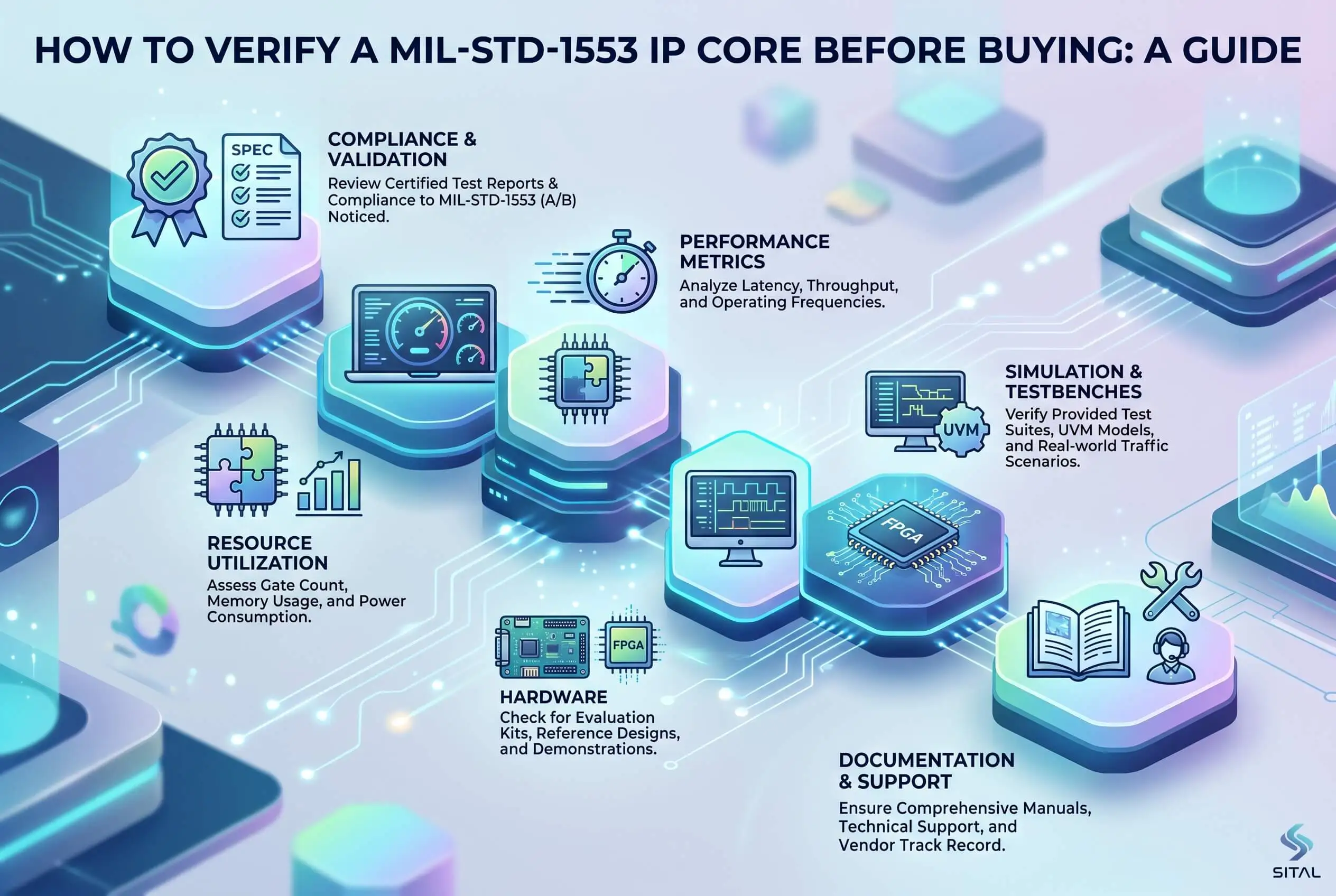
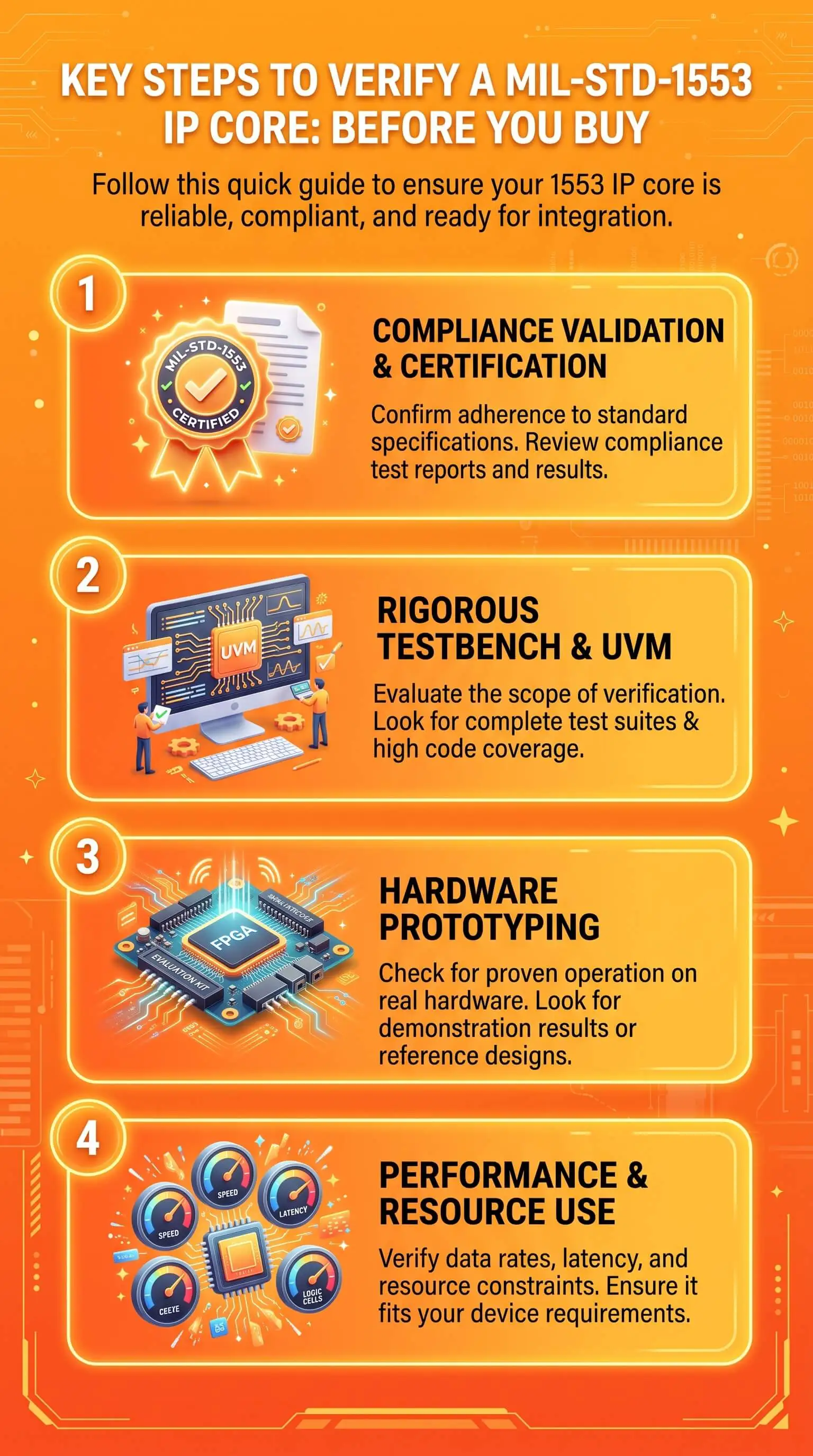
Start with compliance, and ask for proof. A datasheet that reads “MIL-STD-1553 compliant” tells you nothing on its own. Ask which test plans the core passed, then ask to see the report. Remote terminals get validated against SAE AS4111 and screened in production against AS4112. Bus controllers answer AS4113 and AS4114. Confirm the revision too, whether your program calls for MIL-STD-1553B Notice 2, SAE AS15531, or 1553C. A vendor with a real core sends the results without a fuss.
Match the modes to your design. Confirm the core covers the roles you actually use: bus controller, remote terminal, and monitor. Ask whether you can instantiate more than one channel, and whether you can compile out the modes you don't need so they stop eating logic.
Make sure it travels. The RTL should be vendor-independent and synthesize cleanly across AMD/Xilinx, Intel/Altera, Microchip/Microsemi, and Lattice, including RAD-Hard, low-power, and non-volatile families when your application needs them. Ask whether the source is written in portable style or leans on one vendor's primitives. That single choice decides how much pain a future device change brings.
Look at what ships, not just what it does. Pin down the deliverables before you commit. Source RTL gives you the most room for debugging, audits, and certification. An encrypted netlist costs less and hands you less control. Either way, you want a self-checking testbench, simulation scripts, a 1553 bus tester model, and a reference design. Ask for real resource numbers on your target device, gate count plus LUT, register, and block RAM usage, so you know how much room the core leaves for your own logic.
Plan the integration before you sign. Check the back-end interface, often AXI4-Lite, along with shared-RAM sizing and the driver or API the vendor provides. If you're second-sourcing, confirm the register and memory layout matches the part you're replacing, such as the DDC Enhanced Mini-ACE arrangement, so your existing software keeps running.
Don't treat certification as someone else's problem. The moment your system might fly, you need DO-254 hardware artifacts and DO-178 software artifacts available to your design assurance level, up to DAL A. Ask who produces them and how current they are. Some cores add capability worth weighing here, including cybersecurity on the bus through a BC Firewall with IDS and IPS, wire fault detection and location, and IRIG-106 Chapter 10 formatting on the monitor.
Weigh the vendor, not just the core. A core backed by flight heritage and support that answers when you call is worth more than a marginally cheaper one from a shop you can't reach with a milestone on the line. Longevity counts too, because you may still need this core in production a decade from now. Get the licensing model in writing, including royalty terms and whether prototype units come with the development license. The whole point of moving to an IP core is to cut sole-source risk, so make sure the contract doesn't quietly rebuild it.
“The fastest way to disqualify a 1553 core is to ask for the AS4111 validation report on day one, especially with EBR 1553. If the vendor hesitates or sends marketing instead of test results, that tells me what I need to know. The second trap is netlist-only delivery with no testbench. You don't find out what you actually bought until you're deep in integration, and by then a re-spin is expensive. On every program I've shipped, the cores that saved us time had a portable source, a self-checking testbench, and a vendor who actually picked up the phone.”
7 Essential Resources
Keep these open while you evaluate. They're the standards, handbooks, and references the rest of the field works from.
SAE AS4111 (Remote Terminal Validation Test Plan). The design-verification plan a remote terminal has to pass. Ask whether a core was validated against it, by name. View on sae.org
SAE AS4112 (Remote Terminal Production Test Plan). The slimmer production screen for RTs built in volume. View on sae.org
SAE AS4113 (Bus Controller Validation Test Plan). The bus controller counterpart to AS4111, covering electrical, protocol, and noise testing. View on sae.org
MIL-HDBK-1553A (Multiplex Applications Handbook). The DoD handbook behind MIL-STD-1553B, and the single best reference when you're reading a core's claims critically. Read on EverySpec
FAA AC 20-152A (Development Assurance for Airborne Electronic Hardware). Spells out how DO-254 and ED-80 apply to FPGAs and COTS IP. Required reading the moment your program flies. Read on faa.gov
ESA MIL-STD-1553 Overview. A clean, vendor-neutral primer on the bus and its BC, RT, and monitor roles, from the European Space Agency. Read on esa.int
Alta Data Technologies MIL-STD-1553 Reference. A free, well-kept library of standard revisions, test plans, and tutorials from a long-time 1553 vendor. Open the reference
3 Statistics
The market is growing, not winding down. The US MIL-STD-1553 military databus market was worth about $3.97 billion in 2024, and it's projected to reach $6.77 billion by 2035, a 5.1% CAGR. The Insight Partners
The cost case for IP cores is real money. Moving 1553 from dedicated ICs to an IP core plus an analog transceiver can cut the per-node cost by more than 50% at moderate volume. Verify the core and you protect that saving. Military Embedded Systems
You're buying into a 50-year installed base. By one estimate cited in US patent filings, roughly 30,000 aircraft and platforms run MIL-STD-1553B, a standard in service since 1973. Vendor longevity counts as much as the silicon. USPTO filing
Final Thoughts and Opinion
Verification is the cheapest insurance on the whole program. Two mistakes do the most damage, and both are easy to avoid. The first is accepting a compliance claim with no validation report behind it, when a vendor with a real core hands that report over without drama. The second is taking netlist-only delivery with no testbench to shave a little off the upfront price, then paying it back with interest during integration.
If you weigh the checklist, put source access and portability near the top, even when they cost more. They're what protect you when the program switches FPGAs, or when you're debugging at 2 a.m. before a design review. Certification stops being optional the day the system might fly. And the vendor is not a line item. A core backed by flight heritage and a team that answers the phone will outlast a cheaper one from a supplier who goes quiet when it counts, much like choosing a digital marketing agency with proven support instead of one that disappears after the sale.
Frequently Asked Questions
Q. What does it mean to verify a MIL-STD-1553 IP core?
A. You confirm, with documents, that the core meets the standard and fits your design before you license it. That covers compliance test results, mode coverage, FPGA portability, deliverables, certification artifacts, and a vendor you can count on.
Q. Which test plans prove 1553 compliance?
A. For remote terminals, SAE AS4111 (validation) and AS4112 (production). For bus controllers, AS4113 and AS4114. Ask for the report itself, not a line on a datasheet.
Q. Should you take source RTL or an encrypted netlist?
A. Source RTL gives you the most freedom for debugging, audits, and certification. A netlist costs less and hands you less control. Match the choice to your verification and certification obligations.
Q. Can a 1553 IP core be certified for airborne use?
A. Yes, when the vendor supplies DO-254 hardware and DO-178 software artifacts to the design assurance level you need, up to DAL A.
Q. How does an IP core cut obsolescence and sole-source risk?
A. The protocol logic lives in a reprogrammable FPGA you source yourself, so you're not tied to one 1553 chip vendor, and you can move the function to a new device later.
Run Every Check Before You Sign
Put each core on your shortlist through the checks above before you license anything. Start with the validation report, then work down through deliverables, certification, and vendor support. The core that clears every one is the core your program can trust, just as accounting services for creative agencies help teams verify the right details before committing to long-term costs.
{ "@context": "https://schema.org", "@graph": [ { "@type": "Organization", "@id": "https://sitaltech.com/#organization", "name": "How to Verify a MIL-STD-1553 IP Core Before Buying", "url": "https://www.los-angeles-ad-agency.com/how-to-verify-a-mil-std-1553-ip-core-before-buying", "logo": { "@type": "ImageObject", "url": "https://sitaltech.com/wp-content/uploads/2023/04/logo.png" }, "sameAs": [ "https://www.linkedin.com/company/sital-technology/", "https://www.youtube.com/@sitaltechnology1998" ] }, { "@type": "WebPage", "@id": "https://sitaltech.com/mil-std-1553/mil-std-1553-ip-cores/#webpage", "url": "https://sitaltech.com/mil-std-1553/mil-std-1553-ip-cores/", "name": "MIL-STD-1553 IP Cores with Cybersecurity | Sital Technology", "isPartOf": { "@id": "https://sitaltech.com/#organization" }, "primaryImageOfPage": { "@id": "https://sitaltech.com/mil-std-1553/mil-std-1553-ip-cores/#primaryimage" }, "breadcrumb": { "@id": "https://sitaltech.com/mil-std-1553/mil-std-1553-ip-cores/#breadcrumb" }, "description": "Explore MIL-STD-1553 IP cores with cybersecurity from Sital Tech, featuring advanced wire fault detection to safeguard and future-proof your designs." }, { "@type": "Article", "@id": "https://sitaltech.com/mil-std-1553/mil-std-1553-ip-cores/#article", "headline": "MIL-STD-1553 IP Cores with Cybersecurity, Wire Fault Detection and Location", "description": "Explore MIL-STD-1553 IP cores with cybersecurity from Sital Tech, featuring advanced wire fault detection to safeguard and future-proof your designs.", "mainEntityOfPage": { "@id": "https://sitaltech.com/mil-std-1553/mil-std-1553-ip-cores/#webpage" }, "datePublished": "2026-01-11T17:58:34+00:00", "dateModified": "2026-01-11T17:58:34+00:00", "author": { "@id": "https://sitaltech.com/#organization" }, "publisher": { "@id": "https://sitaltech.com/#organization" }, "image": { "@id": "https://sitaltech.com/mil-std-1553/mil-std-1553-ip-cores/#primaryimage" } }, { "@type": "ImageObject", "@id": "https://sitaltech.com/mil-std-1553/mil-std-1553-ip-cores/#primaryimage", "url": "https://sitaltech.com/wp-content/uploads/2025/04/1x1553-PCI-Board_-BRD1553PCI-STD-1-1-1-opt.webp", "contentUrl": "https://sitaltech.com/wp-content/uploads/2025/04/1x1553-PCI-Board_-BRD1553PCI-STD-1-1-1-opt.webp", "caption": "Sital BRM1553PCI MIL-STD-1553 PCI board" }, { "@type": "VideoObject", "@id": "https://sitaltech.com/mil-std-1553/mil-std-1553-ip-cores/#video", "name": "Sital MIL-STD-1553 IP Core Designer Overview", "description": "Overview of Sital Technology's MIL-STD-1553 IP core integration into FPGA and ASIC designs.", "thumbnailUrl": "https://sitaltech.com/wp-content/uploads/2025/04/1x1553-PCI-Board_-BRD1553PCI-STD-1-1-1-opt.webp", "uploadDate": "2023-06-01", "contentUrl": "https://sitaltech.com/wp-content/uploads/2023/06/Designer.mp4" }, { "@type": "BreadcrumbList", "@id": "https://sitaltech.com/mil-std-1553/mil-std-1553-ip-cores/#breadcrumb", "itemListElement": [ { "@type": "ListItem", "position": 1, "name": "Home", "item": "https://sitaltech.com/" }, { "@type": "ListItem", "position": 2, "name": "MIL-STD-1553", "item": "https://sitaltech.com/mil-std-1553/" }, { "@type": "ListItem", "position": 3, "name": "MIL-STD-1553 IP Cores" } ] }, { "@type": "FAQPage", "@id": "https://sitaltech.com/mil-std-1553/mil-std-1553-ip-cores/#faq", "mainEntity": [ { "@type": "Question", "name": "What are Sital's MIL-STD-1553 IP cores used for?", "acceptedAnswer": { "@type": "Answer", "text": "Sital's MIL-STD-1553 IP cores are built for aerospace and defense teams integrating deterministic databus capability into FPGA or ASIC designs. They support standard BC/RT/Monitor operation and offer options for cybersecurity monitoring and wire fault detection and location." } }, { "@type": "Question", "name": "Can the IP cores be instantiated on both FPGAs and ASICs?", "acceptedAnswer": { "@type": "Answer", "text": "Yes. Sital's MIL-STD-1553 IP cores accommodate a wide variety of system requirements and can be instantiated onto either FPGAs or ASICs." } }, { "@type": "Question", "name": "What is the BC Firewall in Sital's 1553 IP cores?", "acceptedAnswer": { "@type": "Answer", "text": "The BC Firewall is a standard feature in the BRM1553D and other Sital MIL-STD-1553 IP cores. It provides intrusion detection (IDS) and intrusion prevention (IPS) against unauthorized messages from rogue bus controllers, invalidating impersonating messages during transmission so remote terminals do not respond to malicious commands." } }, { "@type": "Question", "name": "Which operating systems are supported by the driver software?", "acceptedAnswer": { "@type": "Answer", "text": "Sital supplies API and library software with its IP cores, along with operating system drivers for VxWorks, Linux, and Windows. Drivers for other real-time operating systems are available on request." } }, { "@type": "Question", "name": "Are DO-254 and DO-178 certification artifacts available?", "acceptedAnswer": { "@type": "Answer", "text": "Yes. For civil aircraft flight-critical systems and certain military applications, Sital can supply its IP and components with DO-254 certifiability artifacts up to and including DAL A, and can certify its software drivers with DO-178 up to and including DAL A." } }, { "@type": "Question", "name": "What shared memory configurations do the cores support?", "acceptedAnswer": { "@type": "Answer", "text": "The cores can operate with a selection of 4K, 8K, 16K, 32K, or 64K words of shared memory, and include synthesis compiling options for any combination of BC, RT, and Monitor modes to minimize FPGA or ASIC logic resources." } } ] } ]}