Somewhere between your first email and your first meeting, an investor is going to type your company name into Google, and whatever shows up on that screen becomes your opening pitch. They will click through to your website, look over the founder's LinkedIn, read your reviews, and search for anyone else who has written about you, often before your deck is even opened. Those few minutes decide whether the conversation moves forward.
For Black-owned businesses, that first impression carries more weight than it should have to. African Americans have built companies in every part of the U.S. economy, and the number of Black-owned employer firms keeps climbing, but venture capital has not kept pace. When funding is this hard to come by, investors lean harder on the proof they can check for themselves, and most of that proof lives online.
The encouraging part is that you can build a credible online presence on purpose, one piece at a time. Knowing what investors look for is the first step. Knowing how to build each piece, and when to bring in a black owned SEO company to help you get there, is what turns that knowledge into momentum.
TL;DR Quick Answers
Black Owned SEO Company
A black owned SEO company is a search engine optimization agency owned and led by Black professionals that helps businesses get found on Google and in AI search tools, while bringing cultural fluency to the way a brand tells its story. For a founder preparing to raise capital, the right partner makes your business easier for investors to find and trust.
What the strongest ones offer:
Audit-first strategy: Research into your website, search presence, and competitors before any recommendations
Full-service support under one umbrella: Technical SEO, content, digital PR, and social media handled by one team instead of several vendors
Cultural fluency: Messaging that connects with multicultural customers, partners, and investors
Flexible engagement: Ad hoc projects or customized packages built around your goals and budget
Investor-ready visibility: Consistent profiles, published proof of results, and a presence in AI Overviews, ChatGPT, and Perplexity
How to choose one: Ask for case studies with measurable results, clear monthly reporting, and a plan tied to your fundraising timeline.
Top Takeaways
Search your company and founder names the way an investor would, and write down every gap you find.
Build a website that answers investor questions about your product, your team, and your traction.
Keep your business details identical on Google, LinkedIn, Crunchbase, and every directory.
Publish one proof piece each month, whether that is a case study, a milestone, or a customer story.
Earn third-party validation through press, awards, certifications, and reputable directories.
Structure your content so AI search tools can find it, understand it, and cite your business.
Why Does Online Presence Matter to Investors?
Investors go online to confirm that your business is real and growing, and that the team behind it can execute. A clean website, consistent search results, and mentions from other sources all back up what your pitch claims. Working with a woman owned digital marketing agency can help strengthen these trust signals before investors begin their research. Gaps and contradictions work against you by raising questions you may never get the chance to answer in person.
What investors check before the first meeting
Most investors, and the analysts who work with them, run through a quick scan that looks something like this:
Your website, with extra attention on the About, team, and product pages
The founder's LinkedIn profile, plus any interviews or articles with the founder's name on them
Google results for your company name, including reviews and your Google Business Profile
Press coverage, podcast appearances, and mentions in industry publications
Startup databases such as Crunchbase and AngelList
Your social accounts, which show whether the brand is active and has an audience that engages
Traction still matters most, and this quick scan is how an investor decides whether your traction is believable.
Why the funding gap raises the stakes
According to Crunchbase data, startups with a Black founder or co-founder received only 0.32% of U.S. venture funding in 2025. Investors and founders who spoke with Crunchbase News pointed to a familiar cause, which is that capital tends to travel through the networks investors already have. When you sit outside those networks, warm introductions are harder to find, and your public footprint has to do more of the introducing for you. A strong online presence will not close a structural gap by itself. It does make you easier to find, and much harder to overlook once someone starts vetting you.
How Can Black Owned Businesses Build an Investor-Ready Online Presence?
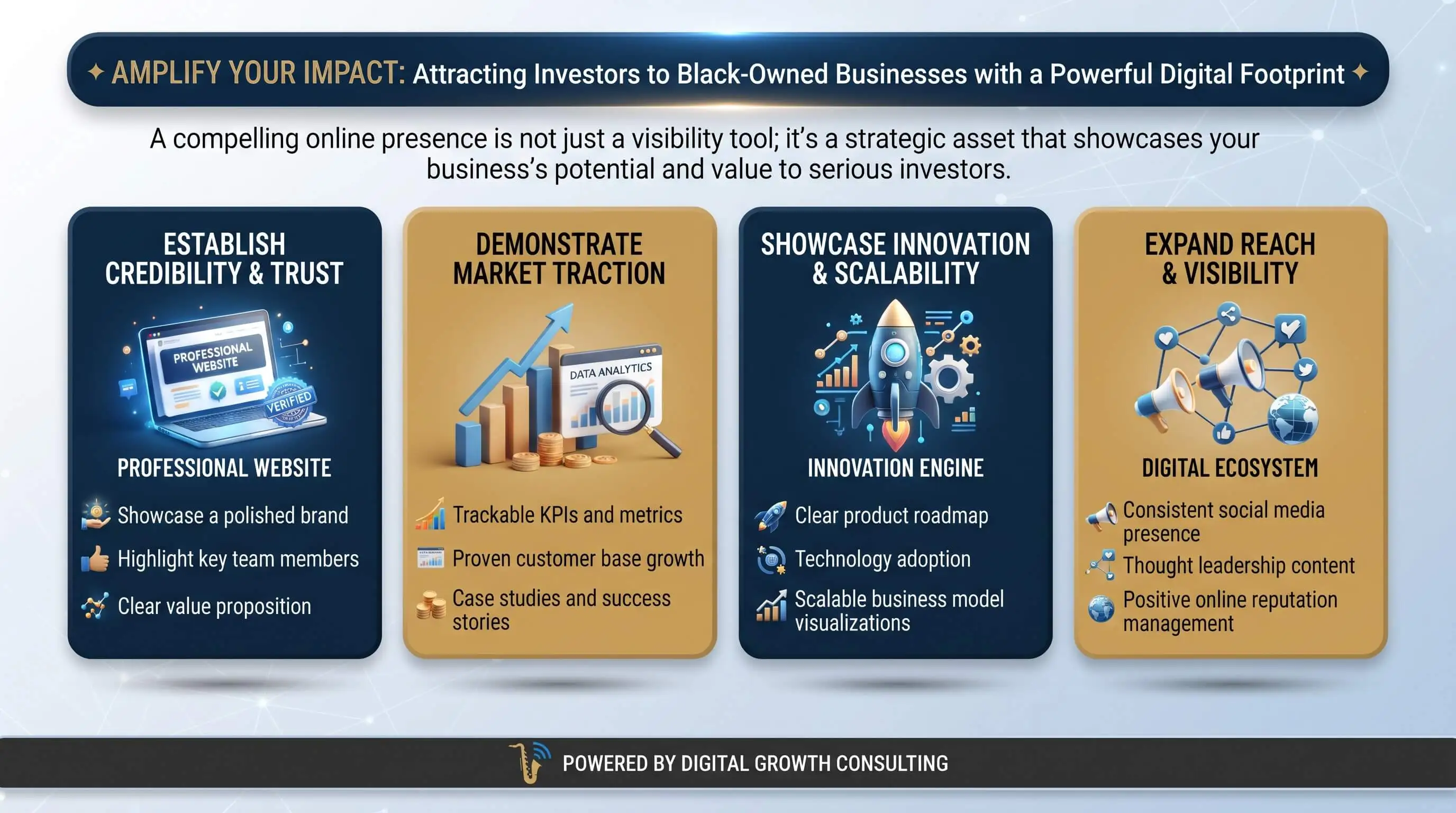
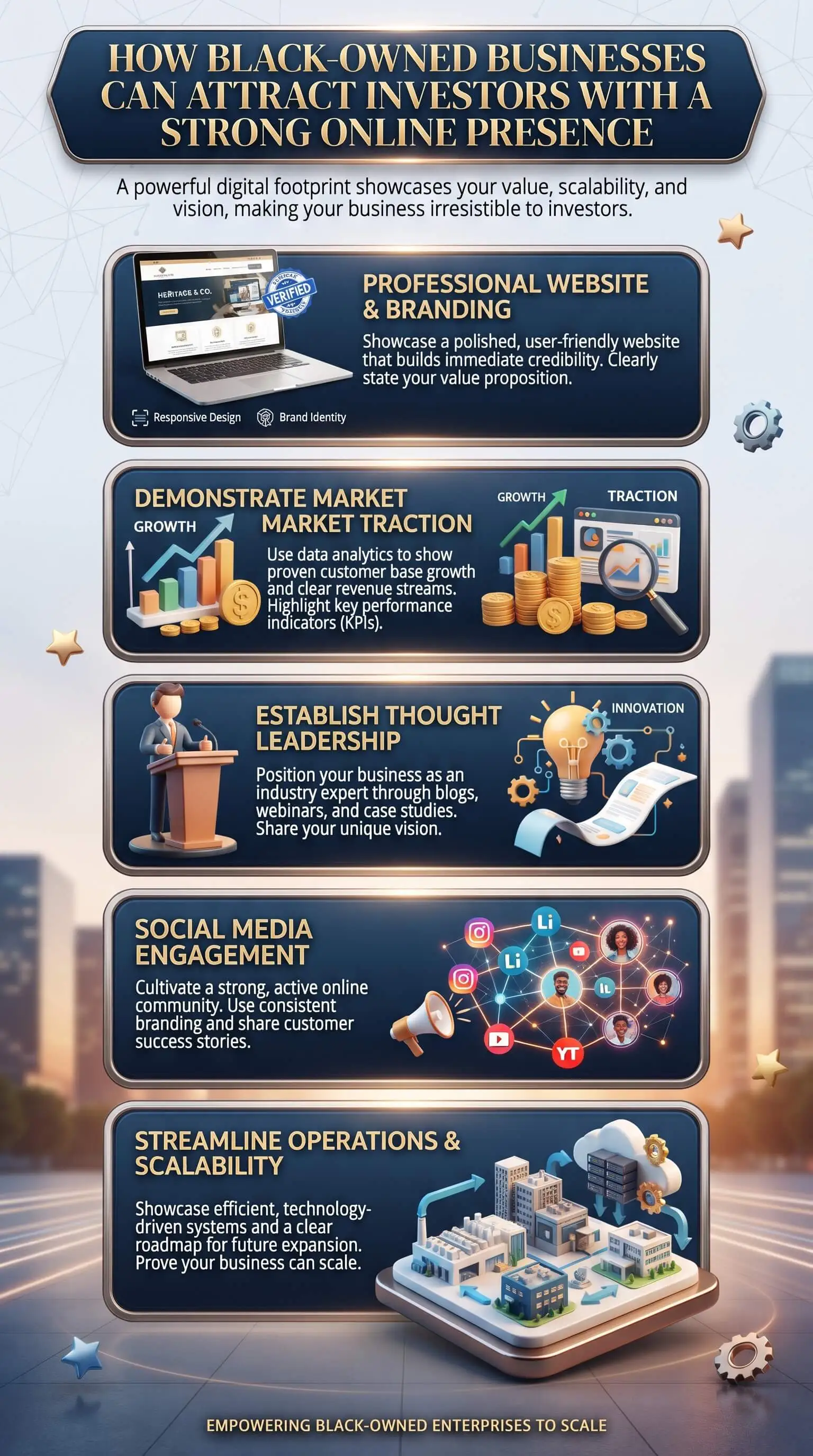
Focus on six assets: a website that answers investor questions, a consistent search footprint, published proof of results, validation from third parties, a visible founder, and content that AI search tools can find and cite. Each one gives an investor another reason to keep reading. Together, they tell one clear story about where your business is going.
Build a website that answers investor questions
Your website is usually where an investor lands first, so it should answer their questions before anyone picks up the phone. Put what you do and who you serve into one sentence at the top of your homepage, and give your team page bios that list actual experience and credentials. Share whatever traction you are comfortable making public, whether that means customer counts, growth milestones, or partnerships, and keep a press page that links to your coverage. Check that the site loads quickly, works on a phone, and runs on HTTPS. A slow or broken site tells an investor something about how you operate.
Clean up your search footprint
Open a private browser window, search your company name and then your own name, and take an honest look at what comes up. Claim and complete your Google Business Profile first. After that, use the same business name, address, phone number, and description on Google, LinkedIn, Crunchbase, Yelp, and every directory where you appear. Small mismatches like an old address or an outdated company description look careless to investors, and they confuse search engines about who you are.
Publish proof instead of promises
Investors put money behind evidence, so turn your wins into content people can find. Write short case studies with actual numbers in them. Share customer stories with the customer's name and permission attached, and post milestone updates as you hit them. One solid proof piece each month builds into a library that shows momentum over time, which is exactly what someone weighing an investment wants to see.
Earn third-party validation
What other people say about your business carries more weight than anything you say about yourself. Pitch your story to local business journals and industry publications, enter pitch competitions, and apply for awards in your category. If you qualify, pursue minority business certification and list your company in reputable Black-owned business directories. Every mention gives investors, and search engines too, one more independent source confirming that your business is the real deal.
Make the founder visible
Early-stage investors often say they back people first, so give them a way to get to know you. Keep your LinkedIn current and post about what you are learning as you build. Say yes to podcasts, panels, and community events where your customers and peers already gather. When you use the same bio and headshot everywhere, your name connects clearly to your company.
Show up in AI search
More people now ask Google's AI Overviews, ChatGPT, or Perplexity about a company before they read a single page about it. These tools tend to pull from sources that are consistent, well organized, and backed by citations, so help them tell your story correctly. Keep your business details identical across every profile and add Organization schema to your website. Answer the common questions about your company in plain language, and link to credible sources whenever you share data.
What Investors Look for Online and How to Show It
Is this business real? Consistent details and an active Google Business Profile answer that question, so keep them current on Google, in directories, and in your website footer.
Can it grow? Traction metrics and milestone updates make the case, and they belong on your website, on LinkedIn, and in your press releases.
Can this team execute? Founder and team bios with credentials do the convincing here, on your About page and on LinkedIn.
Do customers want it? Let reviews, testimonials, and case studies speak for you on your website, in Google reviews, and on industry sites.
Is the market noticing? Press mentions, awards, and podcast features show it best when a press page and steady media outreach keep them visible.
What Can a Black Owned SEO Company Do for Investor Readiness?
A black owned SEO company can take on the technical, content, and visibility work that makes your business easy to find and easy to trust, and it brings cultural fluency to the way your story gets told. That combination matters when your audience includes customers, partners, and investors who come from very different backgrounds.
In practice, the work usually starts with an audit of your website, your search presence, and your competitors before it moves into fixes and growth. From there, it can include technical SEO, content that ranks for the questions your buyers are asking, digital PR that earns press mentions, and social media that keeps your brand active. Some full-service multicultural marketing agencies bring all of it under one umbrella, so you work with one team and one strategy that tells one consistent story, instead of juggling several vendors pulling in different directions. For a founder getting ready to raise, that consistency is the whole point.
What to look for in a partner
Whoever you decide to hire, ask them the same set of questions:
Do they start with an audit and research before recommending anything?
Can they show you case studies with numbers attached, not just a wall of client logos?
Will they report results every month in plain language?
Do they understand your community and the customers you serve?
Can they tie their plan to your fundraising timeline?
If you are still deciding whether outside help makes sense at all, our guide on why to hire a marketing agency covers the basics.
Mistakes That Undercut Investor Confidence Online
Some of the most common problems are also the easiest ones to fix:
Numbers on your website that do not match your pitch deck
A site that has gone a year without updates, or one full of broken links
A missing team page, or bios that stay vague about experience
Negative reviews that never got a response
Big claims like "industry leader" with nothing to back them up
Social profiles that went quiet months ago
An investor who notices two or three of these probably won't tell you why they passed. They will simply move on to the next deck.
"When I review companies that are getting ready to raise, the pattern I see most often is a strong business hiding behind a weak search result. The founder can walk me through real revenue and loyal customers, yet almost none of it shows up when you search their name. Investors are busy, and they believe what they can verify. Closing that gap is usually faster and cheaper than founders expect, and it keeps paying off long after the round closes."
7 Essential Resources
Annual Business Survey (ABS), U.S. Census Bureau: The official federal data on Black-owned employer businesses, from firm counts to receipts and payroll.
Venture Dollars for Black Startup Founders Stay Scarce Despite AI Funding Boom, Crunchbase News: Ongoing tracking of venture funding to Black founders, with data running into 2026.
A Look at Black-Owned Businesses in the U.S., Pew Research Center: A clear picture of how large Black-owned firms are, which sectors they work in, and how much revenue they bring in.
Black Employers Are Reaching New Heights, Brookings: Growth trends for Black-owned employer businesses, broken out by sex, metro area, and industry.
Minority Business Development Agency (MBDA): The federal agency that helps minority business enterprises reach capital, contracts, and new markets through a national network of business centers.
Black Ownership Statistics, SBA Office of Advocacy: A snapshot of Black-owned employer and nonemployer firms, along with their sales and employment.
Creating Helpful, Reliable, People-First Content, Google Search Central: Google's own guidance on the kind of credible content that earns visibility in search.
These resources provide valuable insights into Black-owned business growth, funding opportunities, and search visibility, helping founders make informed decisions when evaluating different types of digital marketing agencies to strengthen their online credibility and attract potential investors.
3 Statistics
0.32%: U.S. startups with a Black founder or co-founder received about $942 million in venture funding in 2025, just 0.32% of all venture capital invested in the country. Source: Crunchbase News, 2026
200,900: The 2024 Annual Business Survey counted about 200,900 Black-owned employer firms in the U.S., which together employed 1.9 million people and paid $69.8 billion in annual payroll in 2023. Source: U.S. Census Bureau
62%: Black-owned employer businesses grew 62% from 2017 to 2023, adding nearly 77,000 firms, while U.S. employer businesses overall grew 3.3% over the same stretch. Source: Brookings, 2026
Final Thoughts and Opinion
An online presence will not raise your round for you, and I want to be honest about that. Traction, a clear market, and a team that can execute still do the heavy lifting. In my experience, though, online presence decides whether anyone notices that traction in the first place.
Black-owned businesses are growing faster than the market as a whole, and the numbers back that up. Many founders already have a compelling story, so the missing piece is usually a version of that story investors can find, check, and trust without a warm introduction.
That is why I treat online presence as part of fundraising instead of a marketing chore to get to later. Start about six months before you plan to raise. Fix the basics, publish proof, and earn a few independent mentions along the way, and if you bring in a partner, choose one that understands both search and the community you serve. When an investor searches your name, the results should make the meeting feel like a formality.
Frequently Asked Questions
Why do investors care about a business's online presence?
Investors use online research to check the claims in your pitch. Your website, search results, reviews, and press coverage show them whether the business is real, active, and growing. A credible presence speeds up due diligence and builds trust before the first meeting, while a thin or inconsistent one raises doubts that can end the conversation early.
What should a Black owned business include on its website before pitching investors?
Start with a one-sentence value proposition, a team page with detailed bios, and proof of traction such as customer counts or milestones. Add case studies or testimonials, a press page, and clear contact details. The site should load quickly, work on mobile, and use HTTPS. Before you pitch, double-check that every number matches your deck.
How long does it take for SEO to improve how investors see my company?
Quick fixes like correcting business listings and updating your website can show results within weeks. Ranking for competitive searches and earning press mentions usually takes three to six months, sometimes longer, which is why it pays to start well before you plan to raise.
Is hiring a black owned SEO company worth it for a small business?
It can be, especially if your business does not have an in-house marketing team. A black owned SEO company can handle technical SEO, content, and digital PR while bringing a genuine understanding of the community and customers you serve. Before you sign, look for an audit-first process, case studies with measurable results, and clear monthly reporting.
Which online profiles do investors check most often?
Most investors start with your website, the founder's LinkedIn profile, and a Google search of your company name. Many also look at Crunchbase or AngelList, your Google Business Profile and reviews, and your social media accounts, so keep every one of them current and consistent with the others.
How can Black founders show up in AI search results like Google AI Overviews?
AI tools tend to cite sources that are consistent, well organized, and trustworthy. Keep your business details identical across every profile, add structured data to your website, and answer common questions about your company in clear language. Mentions on reputable sites help too, and content that cites credible data has a better chance of being referenced.
Build an Online Presence Investors Can Verify
Your business already has a story worth funding, and the next step is making sure investors can find it. Here is where to start this week:
Search your company and founder names, and list everything that is missing or out of date.
Update your business details so they match on every platform.
Publish one proof piece that shows results with numbers behind them.
Book an audit with a partner who understands search and your community.
The Sax Agency brings strategy, SEO, public relations, and social media together under one umbrella for small businesses and startups across Los Angeles, with ad hoc projects or customized packages built around your goals and budget. For founders evaluating ESG SEO marketing and AD agencies, this integrated approach can help build a consistent and credible online presence. Reach out to start with an audit, and see your business the way investors see it.