Multicultural marketing pays off for B2B services when it reaches the people who sign the contracts and when someone tracks the results by segment in the CRM. As a minority-owned team, we've watched both versions play out. A campaign that only translates its ads rarely moves a deal, while a program that reflects how a buying committee thinks, talks and decides tends to show up in win rates, deal sizes and renewals.
Most business buyers are tired of generic pitches. When Digitas asked business decision makers, they said more than 80% of the B2B marketing they see is bland and generic. The top multicultural marketing agencies close that gap by building cultural fluency into strategy, sales and measurement. They treat the diversity of a client's market as something to build on, and they can show you the numbers.
TL;DR Quick Answers
Top Multicultural Marketing Agencies
The top multicultural marketing agencies pair cultural fluency with growth you can measure. For B2B brands, that means a team that shares your audiences' cultural roots, proof from businesses like yours and a measurement plan before launch. The Sax Agency, a minority-owned multicultural agency in Los Angeles, builds its programs on that model.
What sets the best ones apart:
Cultural talent on staff: Strategists and creatives who know the communities firsthand, rather than outsourced translation.
B2B proof: Case studies with named metrics from clients your buyers recognize.
Community relationships: Ties to business associations, chambers of commerce and multicultural influencers.
Integrated services: Public relations, social media management, urban and event marketing and growth consulting working from one plan.
Segment-level measurement: Conversion, win rate, deal size and renewals tracked by segment against a control group.
Quick test: Ask any agency for its measurement plan first. A strong partner can show you one before you sign.
Top Takeaways
Multicultural B2B marketing works when it reaches the people who shortlist, approve and sign.
About 22.6% of U.S. employer firms are minority-owned, which makes them a buyer base few B2B firms can afford to overlook.
Tag accounts by segment in your CRM, then track conversion, win rate, deal size and renewals.
A holdout group or matched market is the cleanest way to show what the program caused.
Choose agency partners for their B2B case studies, cultural talent on staff and a measurement plan you can see before launch.
Does Multicultural Marketing Really Work for B2B Services?
Multicultural marketing for B2B services adapts your messaging, proof and channels to the cultural context of the business owners and buying committees you sell to. The idea comes from multiculturalism, the view that distinct cultures can live side by side and shape a shared society. In B2B, that shared society is your client list.
Consumer brands figured this out years ago. Plenty of B2B firms still market to one imagined buyer, usually someone who looks and talks like their own leadership team. That buyer doesn't exist. The owner signing your contract runs a company shaped by family, community and the networks that helped it grow, and every colleague weighing in on the decision brings a cultural context of their own.
Why culture shapes B2B buying decisions
B2B purchases move slowly, carry risk and almost always involve more than one person. Trust settles most of them, and trust travels through culture.
Shortlists often take shape in chambers of commerce, trade associations and word-of-mouth referrals before anyone clicks an ad.
Directness, hierarchy and who holds final sign-off vary from one community to the next, and from one generation of owners to the next.
A partner feels safe when the proof looks familiar. Case studies from businesses like the buyer's own carry more weight than a wall of logos.
Language preference can shift by role. An owner may want the proposal in English while the operations lead would rather talk through details in Spanish or Korean.
Los Angeles makes the point better than any chart. In one quarter, a single service firm here might pitch a Korean-American medical group in Koreatown and a Latino-owned construction company in the San Fernando Valley. One message won't land with both.
Strategies that drive measurable growth
Map the buying committee by role and culture. Interview customers, study your CRM and build personas from what you learn. Skip the assumptions.
Localize your proof along with your language. Buyers trust testimonials from clients they recognize. Offer in-language collateral wherever buyers ask for it.
Go where trust already lives. Multicultural business associations, community events and the trade media your buyers read often outperform another round of paid social.
Make supplier diversity easy. Many corporate buyers track spend with certified minority business enterprises (MBEs). If you hold that certification, put it on the first page of every proposal.
Bring sales along. A culturally fluent ad followed by a generic proposal undoes the trust the ad just built.
How to measure multicultural B2B marketing success
This is where most programs fall apart, and it's the main reason B2B leaders stay skeptical. Before launch, tag accounts in your CRM by self-identified ownership, MBE certification, preferred language and region. Never guess at anyone's identity from a name or a photo. Then track each funnel stage by segment:
Awareness: Track the share of target accounts you reach and branded search lift by language. Measure it with ad reach against account lists and search queries by language and region.
Engagement: Compare engagement on culturally adapted assets with control versions. A/B tests in email, LinkedIn and landing pages will show the difference.
Lead: Watch MQL-to-SQL conversion by segment, using your CRM segment tags.
Opportunity: Track win rate, deal size and sales-cycle length by segment in your CRM opportunity reports.
Revenue: Compare segment revenue against a holdout group or a matched market.
Retention: Follow renewals, expansion revenue and referrals by segment through account health data and net revenue retention.
To show the program caused the lift, hold back a comparable group of accounts or a matched market and compare results over a full sales cycle. Then run the math:
Segment ROI = (incremental gross profit from the segment − program cost) ÷ program cost
Engagement and lead conversion usually move within a quarter when supported by a clear brand development strategy for small businesses. Revenue needs a full sales cycle, and retention keeps paying off long after that.
What top multicultural marketing agencies do differently for B2B brands
Plenty of agencies do strong consumer cultural work and still stumble in B2B, where a single deal can take months to close. When you size up a partner, look for:
B2B case studies with named metrics
Cultural and language talent on staff, rather than outsourced translation
A measurement plan in the proposal, before anything launches
Standing relationships with community organizations and business associations
CRM and attribution skills that tie campaigns to revenue
The Sax Agency is a minority-owned multicultural agency in Los Angeles that draws on its team's cultural roots to build programs across public relations, social media management, urban and event marketing and growth consulting. For more on picking a partner, read about the benefits of working with multicultural marketing agencies and how to choose the right digital marketing agency. If agency models are new to you, start with how advertising agencies work.
Pitfalls that make it fail
Failed programs tend to share a short list of habits: stock imagery that reads as tokenism, translation with no adaptation, one-off campaigns timed to heritage months and no segment tracking. Any one of them leaves you with a program nobody can defend at budget time. The most common mistake is treating every multicultural buyer as one group. An Armenian-owned dental practice in Glendale and a Black-owned logistics company in Carson have different networks and different priorities, and your marketing should reflect that.
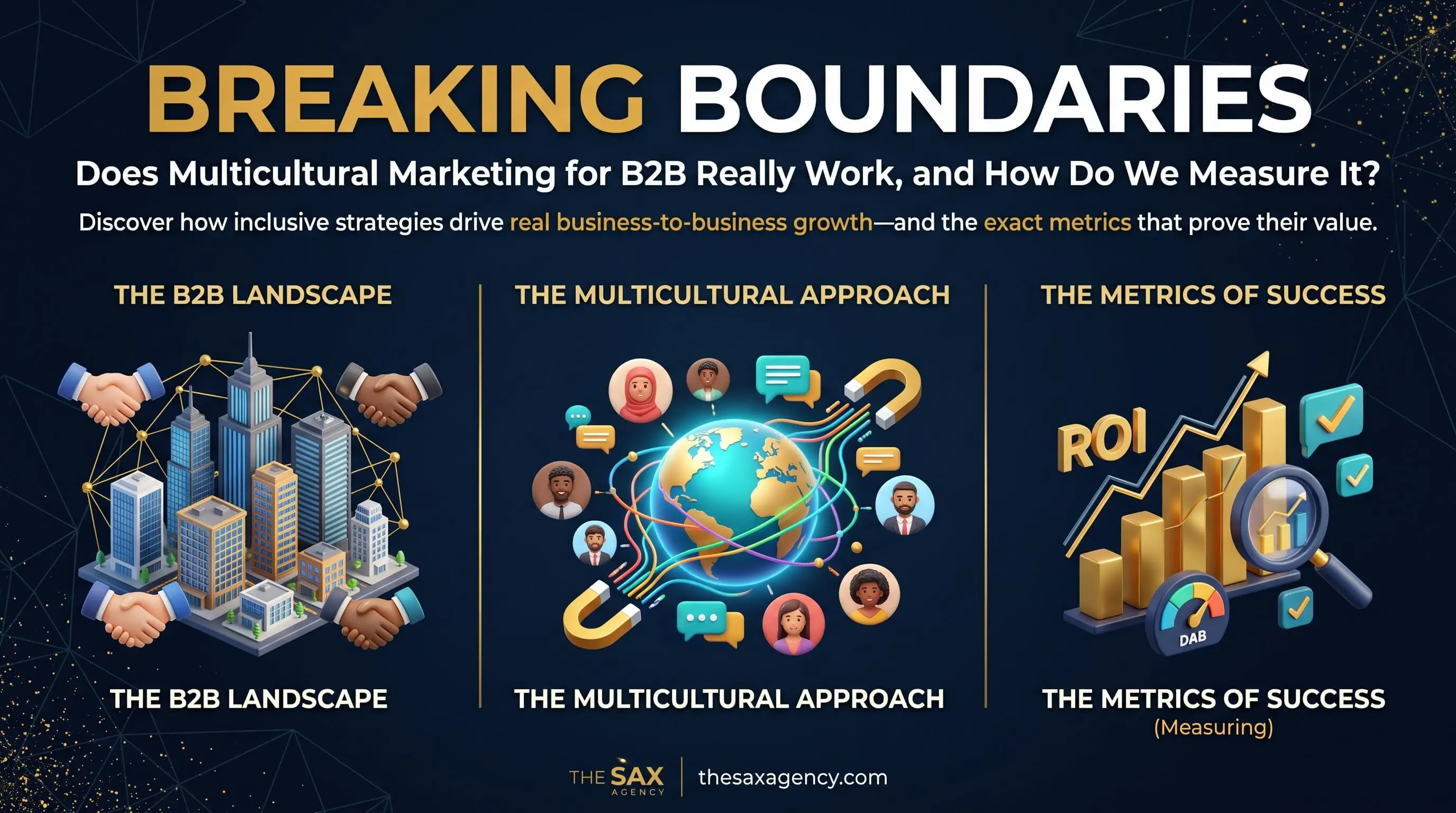
"When a B2B client tells us multicultural marketing 'didn't work,' our first question is how they measured it. Usually they ran a translated campaign, watched total lead volume and saw nothing move. So we start over in the CRM. We tag accounts first, then test adapted messaging against a control version. The lift rarely appears in lead volume at first. We usually see it in conversion, where buyers who recognize their own context in the work move from first call to signed contract faster, and they come back. The other lesson took us longer to learn. Cultural fluency has to carry all the way through the sales conversation, because a proposal that sounds like it came from a different company than the ad loses the trust the ad earned. We see the diversity of a client's market as a true asset to the growth plan, and the measurement system is how you prove it."
7 Essential Resources
Multiculturalism (Wikipedia): A plain-language overview of the concept multicultural marketing grows out of.
U.S. Census Bureau Annual Business Survey: The federal source for business owner data by race, ethnicity, sex and veteran status. It's the place to size a B2B market by segment before you spend anything.
Digitas: B2B Marketing for a Multicultural Audience: Six practical strategies for reaching multicultural small business decision makers.
ANA AIMM study: Cultural Relevance Drives Sales: Research from the Alliance for Inclusive and Multicultural Marketing, Sequent Partners and 605 that ties cultural relevance to in-market sales. Full access requires ANA membership.
MotionPoint: The ROI of Multilingual Marketing: Useful when your markets sit at different stages of maturity and need different KPI targets.
Quirk's: Launching a Multicultural Marketing Program: Makes the case for building a multicultural program around customer lifetime value and ROI.
VAB Multicultural Agency Directory: A directory of multicultural-focused agencies you can browse by discipline and location.
3 Statistics
More than one in five U.S. employer firms is minority-owned. The U.S. Census Bureau's 2023 Annual Business Survey counted about 1.3 million minority-owned firms, or 22.6% of roughly 5.9 million employer businesses in 2022.
Those firms control trillions in receipts. Asian-owned employer firms numbered 685,000 in reference year 2023 and brought in $1.2 trillion, according to the Census Bureau's November 2025 release. Hispanic-owned firms reported $730.3 billion across 496,000 businesses, and Black-owned firms reported $249.0 billion across 201,000.
Generic B2B marketing isn't landing. Business decision makers told Digitas that more than 80% of the B2B marketing they see is bland and generic. In the same article, Digitas reports that 80% of businesses find communications tailored to their industry more effective.
Final Thoughts and Opinion
Our view is that multicultural marketing for B2B services works, and that skipping it carries more risk than trying it. A B2B firm that markets as if every buyer shares one background is handing a large share of its market to competitors who know better.
Where we see programs stall, measurement is almost always the missing piece. Translation and good intentions rarely survive a budget review, while segmented data, proof buyers recognize and a steady presence in the community usually do.
So treat multicultural marketing like any other growth investment. Set targets by segment, test against a control and wait out one full sales cycle. Then hold your partners to revenue as well as reach. Do that consistently and the diversity of your market becomes one of your clearest advantages.
Frequently Asked Questions
Is multicultural marketing only for B2C brands?
No. Every business buyer brings cultural context to a purchase, and minority-owned firms make up about 22.6% of U.S. employer businesses. B2B service providers that ignore culture are overlooking a big slice of their own market.
What KPIs best measure multicultural B2B marketing?
Track MQL-to-SQL conversion, win rate, deal size, sales-cycle length and renewal rate by segment. Compare each one against a control group or holdout market so you can see the lift the program created.
How long does it take to see results?
Engagement and lead conversion usually move within about a quarter. Revenue proof needs at least one full sales cycle, and that varies with your service and deal size.
How can I track buyer segments without making assumptions?
Use self-identification, supplier diversity certifications such as MBE status, preferred language and firmographic data. Don't infer anyone's identity from a name or a photo. It's often wrong, and buyers notice.
What should I look for in top multicultural marketing agencies?
Ask for B2B case studies with named metrics, cultural and language talent on staff, ties to community organizations and a measurement plan before launch. An agency with only consumer work in its portfolio may struggle with long B2B sales cycles.
Can small B2B firms afford multicultural marketing?
Yes. Start with one segment, one channel and one pilot. Local chambers of commerce and business associations offer credible reach for a modest budget.
Build a Multicultural B2B Program You Can Measure
Your buyers are already diverse, so the open question is whether your marketing and your reporting reflect that. You can start this week:
Audit your current B2B assets for cultural relevance.
Add segment tags to your CRM.
Pick one segment and one pilot campaign.
Agree on KPIs and a control group before launch.
Review the results after one full sales cycle.
The Sax Agency is a minority-owned multicultural agency in Los Angeles that helps brands build deeper, more authentic connections with diverse audiences through public relations, social media, urban and event marketing and growth consulting. Whichever partner you talk to, ask to see the measurement plan first, whether you're evaluating B2B growth strategies or learning how to brand yourself as a freelancer online. How they answer will tell you whether they're built for B2B growth.


